Supplementation is one of the most confusing areas of fitness for those first starting. What should you and shouldn’t you use? What products actually work? Which brands are the best? To make it easier on you, in this post I’ll be outlining the contents and benefits of different types of protein powders and my review on popular brands.
What’s in protein powder?
One thing to keep in mind when buying supplements is that they are not regulated by the FDA. There could be harmful chemicals present that aren’t listed in the nutrition facts. Some supplements are labeled as health products, when there are 20-30 grams of sugar inside. So, it’s important to do your research on your products and the companies you’re buying from. And of course, supplements are, well, supplements! You can’t rely on them alone to meet your daily dietary needs. Always speak with your medical provider prior to adopting any supplements into your diet.
Whey protein is the most common form of protein powder. Whey is the protein found in the liquid strained from curdled milk. Sounds disgusting, right? It actually has many benefits. Not only does it support muscle growth, but it has been shown to promote bone growth, improve cognitive function, and lower cholesterol1. It is considered a complete protein, meaning it contains all the essential amino acids that our bodies cannot produce on their own2. Casein is the protein that comes from the remaining curdled milk. This is much less common than whey protein. The main difference between the two is that it takes longer to digest casein, keeping you full longer3.
Soy, brown rice, and pea protein are the most common plant based options. Soy is a complete protein made from soybeans. There is much controversy about the presence of phytoestrogen in soy protein isolate, which mimics the hormone estrogen in your body and can be harmful in excess4. Natural soy products such as tofu have been shown to lower cholesterol, but soy isolate may cause more harm than good5. Pea protein is an incomplete protein made from split peas3. While it is incomplete, it has antioxidant properties, promotes gastrointestinal health, and can lessen disease symptoms6. Brown rice protein is made from the separation of protein and carbohydrates within brown rice3. It contains even less of the essential amino acids than pea protein, but has been shown to maintain healthy cholesterol levels3.
Studies have shown that whey protein is more effective at stimulating muscle synthesis than soy protein7. Additionally, whey and soy protein were both more effective in muscle synthesis than casein, due to the fact that they are digested much faster7. Overall, it is difficult to find a definitive answer on which is “easiest” for the body to digest. It is often dependent on the individual and their dietary habits and restrictions.
Protein Reviews
I have tried many brands of protein powder from basic grocery store products to premium products from GNC and online stores. I prefer to blend my protein into smoothies, so the basic chocolate, vanilla, and strawberry flavors always pair well. Of course, whey protein has a creamy taste and vegan protein has a green taste. For myself, I find that plant protein will upset my stomach at times. However, for dairy free individuals it’s a great alternative to whey. It’s different for everyone, so explore your options!
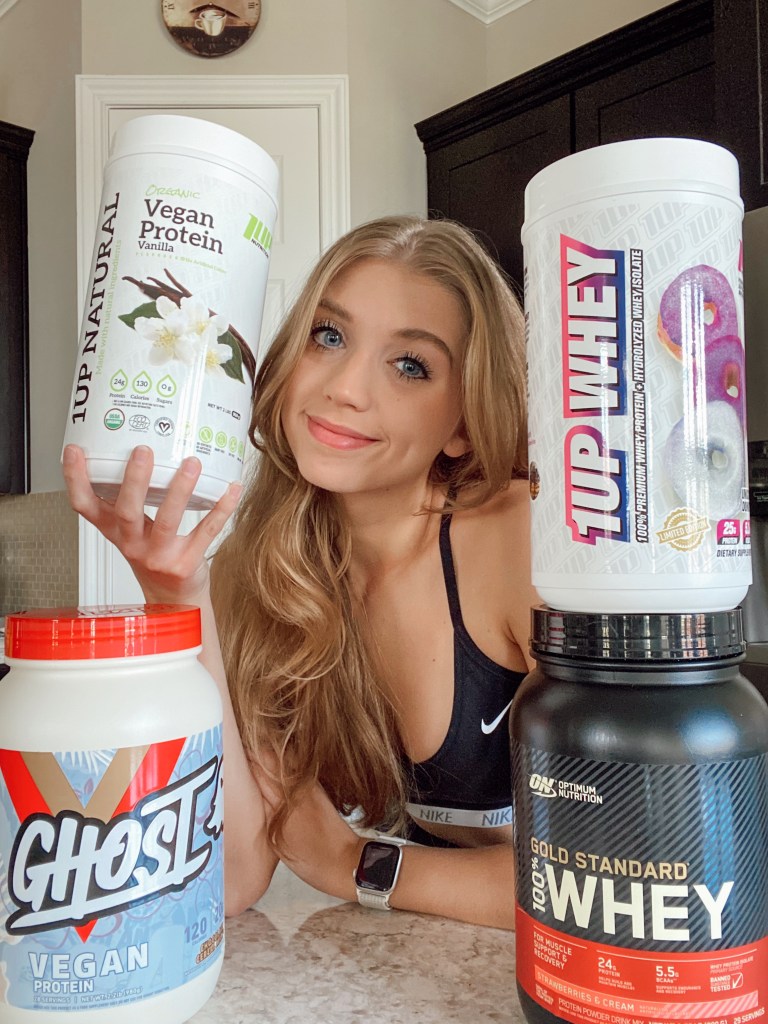
I’ve tried both whey and pea protein from 1up Nutrition. In my opinion, the taste does pair well with smoothies but isn’t very good on its own. Their whey protein contains around 3-4 grams of fat and 4 grams of sugar. I’ve found that the whey protein is a little too sweet for my liking. The pea protein is very high quality with 100% natural ingredients. It is a USDA certified organic product and certified vegan product. It’s also sweetened with stevia so there’s 0 grams of sugar and 2 grams of fat. It is definitely my top choice for vegan proteins!
Ghost is an incredibly trendy brand right now. They have done collaborations with sour patch kids, chips ahoy, and more for their supplements. I have only tried their vegan chocolate cereal milk flavored protein. I think it tastes great in smoothies and by itself. I was amazed that it tasted so good with 0 grams of sugar and only 2 grams of fat. It’s made of a mixture of pea, pumpkin seed, and watermelon seed protein. This protein however made me feel much more full than the 1up pea protein even though their ingredients are very similar.
My current favorite is my Optimum Nutrition strawberries and cream flavored whey protein. It tastes great by itself and in smoothies. It contains 24 grams of protein and 5.5 grams of BCAAs (branched chain amino acids). BCAAs contain some of the essential amino acids we previously discussed, plus additional amino acids that aid in muscle recovery. It has 1 gram of fat and 1 gram of sugar. This is my top choice for whey proteins.
Which should you choose?
At the end of the day, the protein you choose is highly dependent on your lifestyle and dietary restrictions. Based on my own research, I choose not to consume soy protein. I personally use both whey and pea protein, depending on my consumption of animal products that day. For those who exercise regularly, protein powder is an excellent supplement to aid in muscle growth. Like I said before, make sure to consult either your dietician or doctor prior to taking any supplements. Comment below any questions you have or protein powder recommendations!
Sources
- Krissansen, G. W. (2007). Emerging Health Properties of Whey Proteins and Their Clinical Implications. Journal of the American College of Nutrition, 26(6). doi:10.1080/07315724.2007.10719652
- Team, W. (2020, October 14). Do I Need to Worry About Eating ‘Complete’ Proteins? Retrieved December 21, 2020, from https://health.clevelandclinic.org/do-i-need-to-worry-about-eating-complete-proteins/
- Admin. (2018, March 06). Pros And Cons Of Different Protein Powders. Retrieved December 21, 2020, from http://fitcolony.com/pros-cons-different-protein-powders/
- Daniels, C. (2018, December 07). Does Eating Soy Increase Estrogen Production? Retrieved December 21, 2020, from https://healthyeating.sfgate.com/eating-soy-increase-estrogen-production-2870.html
- Robinson, K. (2014, May 16). Soy Protein and Cholesterol: Benefits, Risks, How Much to Eat. Retrieved December 21, 2020, from https://www.webmd.com/cholesterol-management/features/soy-and-cholesterol
- Ge, J., Sun, C., Corke, H., Gul, K., Gan, R., & Fang, Y. (2020). The health benefits, functional properties, modifications, and applications of pea ( Pisum sativum L.) protein: Current status, challenges, and perspectives. Comprehensive Reviews in Food Science and Food Safety, 19(4), 1835-1876. doi:10.1111/1541-4337.12573
- Tang, J. E., Moore, D. R., Kujbida, G. W., Tarnopolsky, M. A., & Phillips, S. M. (2009). Ingestion of whey hydrolysate, casein, or soy protein isolate: Effects on mixed muscle protein synthesis at rest and following resistance exercise in young men. Journal of Applied Physiology, 107(3), 987-992. doi:10.1152/japplphysiol.00076.2009
 BrainsNGains